ParadocX
The design division of BPS Knives. We develop fixed and folding knives for serial production — our own models, and commissions for other brands and manufacturers.
The obvious solution is usually the second best one
The triangle in our mark works on paper and nowhere else. Every joint in it is honest. The assembly is a lie. You can measure each angle, confirm each edge, and still be holding a drawing of an object that cannot be built.
We keep it because that is the shape of the work. A brief almost always contains a contradiction: it wants a thin blade and a strong tip, a slim handle and a lock you can reach with gloves on, a premium object at a price the factory can hit. Stated plainly, most briefs look impossible.
So we do not start from a shape someone has already drawn. We start from the constraints: what the piece has to do, what the steel and the handle material will allow, what a production line can actually hold to within a tenth of a millimetre.
The interesting answers live where those pressures disagree. A grip that improves the lock geometry. A grind that removes a machining step. A handle contour that makes a cheaper material read as expensive. Our job is to keep looking past the first workable idea until we find the one that resolves several problems at once — and still looks like something you want to pick up.
A shape that only works once you find the angle
- THE TRIANGLE
- A Penrose tribar with a P cut out of it. Every corner is correct; the whole reads as impossible until you see how it is put together. That is the kind of answer we are after in a knife.
- THE GRID
- A form like that only holds in isometric projection, where parallel lines never converge. It is the projection engineers draw in — and the reminder that a concept sketch and a production drawing are not the same document.
- THE RING
- A protractor, graduated every ten degrees. Nothing leaves the studio unmeasured: a drawing that cannot be dimensioned, toleranced and handed to a factory is not a design yet.
- THE THREE RED TICKS
- Fifteen, seventeen and twenty. They sit off the ten-degree rhythm because they are edge angles, not bearings — the kind of detail that decides whether a knife cuts well, and the kind we would rather argue about than leave to chance.
Twelve stages from brief to production
Every project runs the same route. Some stages take a day, some take a month, but none of them get skipped — most of the cost of a bad knife is spent long before anyone cuts steel.
It is a slow method and it kills more drawings than it passes. Concepts that survive the sketch stage die at construction, and shapes that survive construction die when the material quote comes back. What comes out the other end has been looked at from every side there is.
Two stages are marked below. Those are the points where the client signs off: once a direction is chosen and once the final revisions are agreed. Everything between them is our work to get right.
What we design
- FIXED KNIVES
- Bushcraft, outdoor, kitchen, utility. Full-tang and hidden-tang constructions, sheath geometry included where it affects the design.
- FOLDING KNIVES
- Lock and pivot engineering, detent and stop-pin geometry, clip and carry position, ergonomics in both open and closed states.
- SINGLE MODELS
- One knife, taken from an idea or a written brief through to a production-ready package.
- FULL LINES
- A family of models built on shared visual language, shared components and shared tooling, so the range holds together and costs less to make.
- FOR BRANDS AND MANUFACTURERS
- Design under your own name. We work to your positioning, your price point and the tolerances your production can hold, and hand over drawings your engineers can build from.
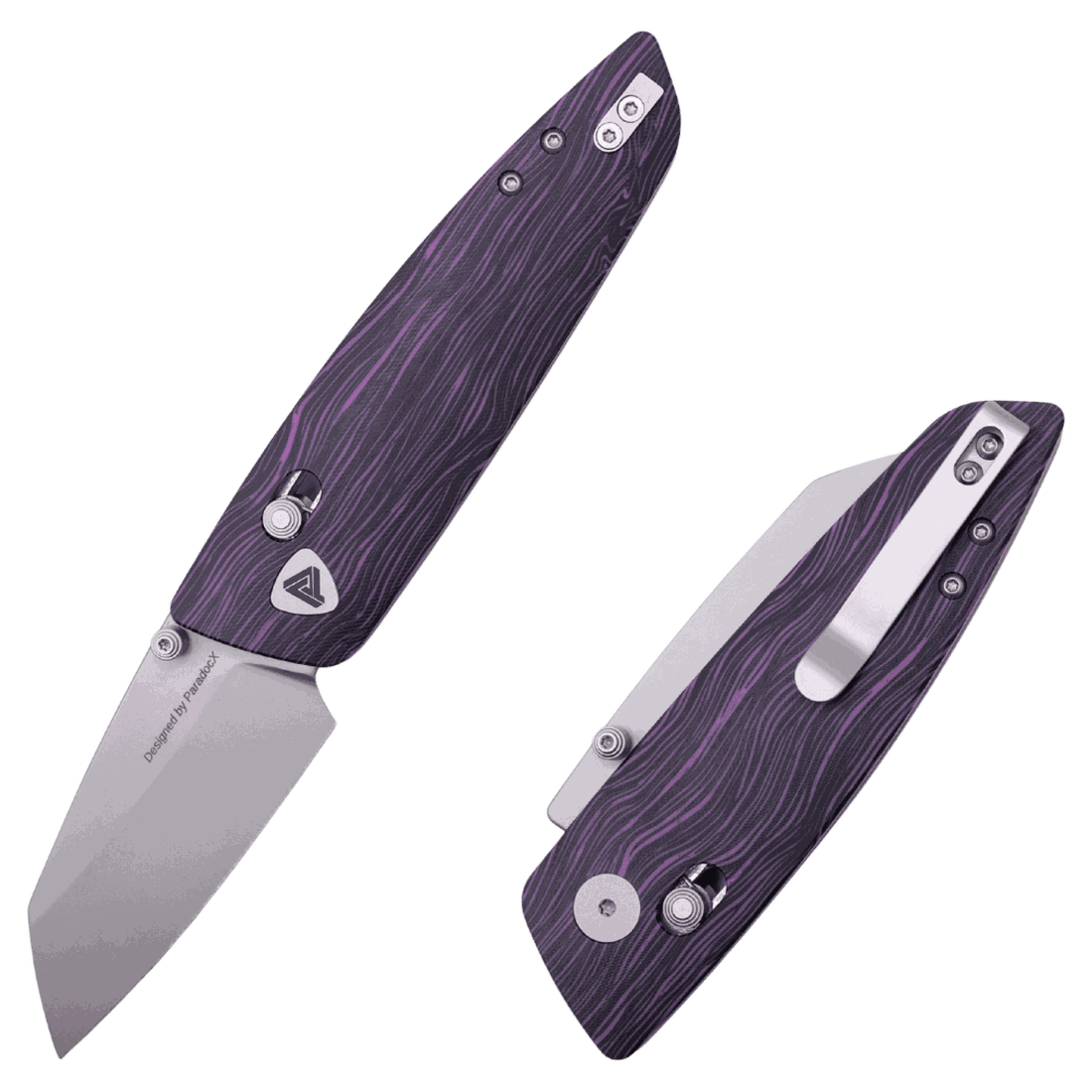
Halo
A halo is a ring of light that appears only at the right angle, and only for the person standing in it. The handle does the same: G-Mascus whose grain runs in purple and black bands that shift as the knife turns in the hand, so no two scales read alike.
A sheepsfoot blade in Nitro-V, bead blasted to a flat grey that takes the shine off the geometry and leaves the shape to do the work. The straight edge is deliberate: it sharpens on any stone, and it keeps the tip low and controllable for the cutting most people actually do.
Crossbolt lock, so it opens and closes with either hand and never puts a finger in the blade path. An ambidextrous clip. The tribar inlaid in the scale beside the pivot, and “Designed by ParadocX” etched along the blade — the first model we drew for ourselves rather than to a brief.
- TYPE
- Folder
- LOCK
- Crossbolt
- STEEL
- Nitro-V, 59–61 HRC
- FINISH
- Bead blast
- BLADE
- Sheepsfoot, 75 mm
- CUTTING EDGE
- 71 mm
- BLADE WIDTH
- 31 mm
- SPINE
- 3 mm
- HANDLE
- G-Mascus
- CLIP
- Ambidextrous
- OPEN / CLOSED
- 185 / 113 mm
- WEIGHT
- 125 g
A design division of BPS Knives
ParadocX began as the in-house design team at BPS Knives, drawing the models the company put into production. Working against real tooling, real steel costs and real order volumes taught us the difference between a drawing that looks good and one a factory can hold.
It is now a separate design division taking outside commissions. BPS remains our closest client and the place our own models are made and sold — but the studio designs for other brands and manufacturers on their own terms, under their own names.
Bring us a brief, or just an idea
Tell us what the knife has to do and who it is for. We answer every enquiry, and we say no when the project does not fit us.
Not ready yet? We announce new models to the list first.